What happened:
Although children have quite a low chance of catching a serious case of COVID-19, they have arguably born the brunt of the restrictions.
Childhood obesity rates climbed as they lost out on exercise. Social isolation took a toll as they were kept home from school and away from friends. And many felt the stress from parents who were forced out of jobs due to draconian COVID restrictions.
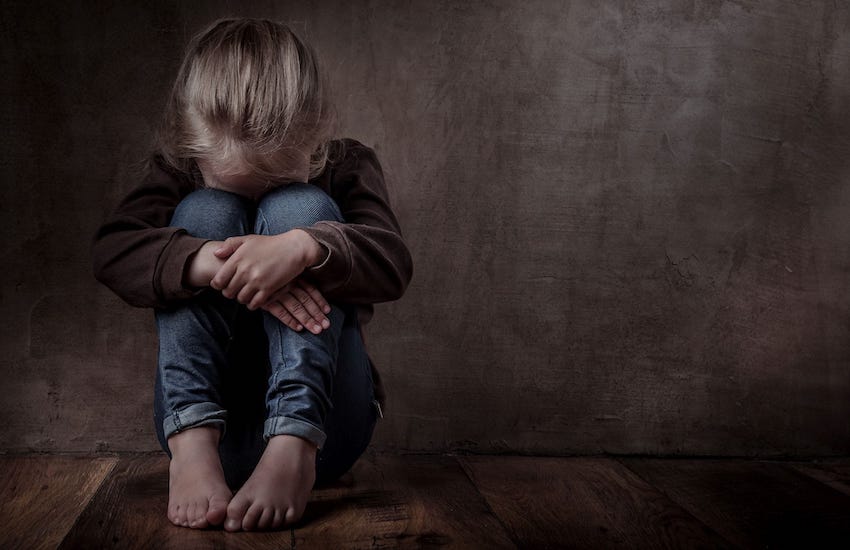
Now the effects are showing up in a mental health crisis among youth.
In the first half of 2021, US children’s hospitals reported a 45% increase in cases of self-injury and suicide among 5-17 year-old children, compared to 2019, according to the Children’s Hospital Association.
Earlier in the pandemic from March through October of 2020, mental health-related emergency room visits rose by 24% for children ages 5-11 and 31% for children ages 12-17.
In October, the American Academy of Pediatrics (AAP) declared a national emergency in children’s mental health.
But the AAP might have helped contribute to the problem…
Earlier this year, the organization was caught removing resources from its website on the importance of facial cues in childhood development.
This was part of the AAP’s push to deny that any mental health harm would come from masking children in school, or masking their caregivers.
According to the AAP’s old stance, it is reasonable to conclude that masking kids and caregivers could make it harder for children to relate to and understand each other, teachers, and parents.
Without those important facial cues bonding breaks down, social anxiety increases as it is harder to understand and be understood. And children can be left feeling more isolated and confused.
What this means:
Go figure, tying masks to kids faces, and dividing them with the victim/oppressor mentality of Critical Race Theory leads to worse mental health.
Plus, the constant division that kids see and feel — their parents’ battles at the local school board meeting over policies and even in the neighborhood over politics — isn’t a healthy environment.
Now the schools want to be more involved in kids’ mental health…
But to some activist school psychologists and guidance counselors, that might mean convincing a child that all their mental anguish stems from gender dysphoria, as one family experienced in Washington state.
Between public schools and COVID insanity, it’s a minefield trying to raise a child right now. But you and your children don’t have to walk through it.
What you can do about it:
The feeling of powerlessness causes many mental health problems in both adults and children.
So it is important to create an environment for kids (and yourself) where they feel the freedom to be themselves.
As part of a Plan B, we talk a lot about finding the right place to live, and considering options all around the world.
But wherever you live currently, don’t forget to make your home a sanctuary, a peaceful, productive, inspiring environment where you love to be.
This could be as simple as adding plants, running water, or something stimulating or fun.
Turn an extra bedroom into an art room, with paints and a pottery wheel. Or invest in something to keep the family active, like a home gym or a ping-pong table.
Whatever your family’s interests or style, you could find a way to make the home environment special if you see outside forces having an impact on your family’s mental health.
You could consider giving your children more freedom by allowing them to paint their bedroom however they like, pursue a backyard project, or take over the basement. You could couple this freedom with extra responsibility if they have an interest in, say, keeping chickens or starting a side business.
After all, if you want to raise children who value freedom and independence, it makes sense to find ways to instill those values at an early age.
Parents also have the power to create a healthy mental environment for their kids through homeschooling.
We’ve talked about this before. It is legal to homeschool in every state in the US, Australia, New Zealand, Canada, and the United Kingdom.
It is also legal to homeschool in Portugal and Mexico.
There is also a market opportunity.
Clearly parents are fed up with the quality and direction of public education. And public schools are not serving kids’ mental health needs — or teaching them what they need to be successful in life.
And there are also a lot of teachers fed up with public schools — what they are forced to teach, and vaccination mandates, to name a couple grievances.
Already the number of homeschooling families has doubled since the start of the pandemic.
But many more parents may not have the time, type of job, or skills to homeschool their own children.
They might be happy to find offers where several homeschool families come together to form homeschool pods, or access special group tutoring rates.
Others parents may prefer to send their children to private school, but are turned off by the similar style of teaching to public school, or the price of most private schools.
Over half of US states currently offer some type of school choice. That means public funds can follow an individual student to another public school, to pay for private school, tutoring, or even homeschool expenses (it differs by program and state).
School vouchers allow the amount of public money spent per student to be instead used for private school or tutoring programs.
Some states will deposit a portion of state funding into an educational savings account if a student unenrolls from public school. This account can then be used to pay for a number of alternative schooling expenses, including online classes.
Other states give tax credits to parents who do not use the public school system.
And the number of states with school choice programs is growing. In fact, it may be a welcome solution to the anger many parents are expressing over the direction of their local schools.
So for anyone who has the credentials and business acumen, K-12 education could be a hot market to target.
