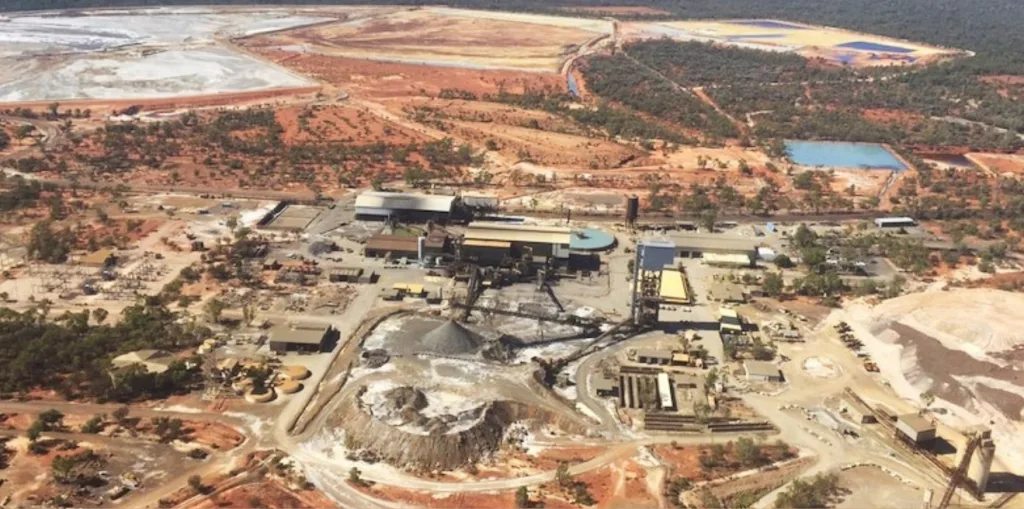
In the summer of 1914, the miners of Broken Hill had less reason to fear a European war than almost anyone under the British flag.
Their town had risen out of the bare red desert of far western New South Wales, built on top of a single ridge of ore, miles long and packed with silver, lead and zinc, that ranked among the greatest mineral finds in history. The nearest sea was hundreds of miles away, and beyond it an ocean stood between them and the fighting.
Yet the metal coming out of that ground was not really Australia’s to sell. Years earlier, it had been quietly signed over to Germany.
The reason came down to a problem the town could not solve on its own. Broken Hill could dig the ore, but it could not turn it into finished metal. That took smelters, and Australia had almost none. Germany had them in abundance.
So a German firm called Metallgesellschaft, which by 1909 controlled much of the world’s trade in lead and zinc, bought Broken Hill’s raw concentrate, shipped it halfway around the planet, smelted it in Germany and Belgium, and sold the finished metal on to the world. Even the biggest mining company at Broken Hill, the one we now call BHP, had signed contracts locking up its ore for the Germans until 1921.
None of it looked like a danger. The ore was Australian; it simply happened that the only people who could turn it into metal were German.
But zinc, dull as it sounds, is a war metal. Alloyed with copper it becomes brass, and brass is what a cartridge case is made of, and a shell casing, and the fittings of an army at war.
Then, in August 1914, Germany invaded Belgium, and the British Empire found itself at war with the country that made its zinc.
Overnight, those smelters became enemy property. The Empire owned the richest zinc lode on earth, and it counted for nothing, because there was nowhere left to turn the ore into metal.
So the mines shut, and thousands of miners walked off the job in the middle of a war that could not get enough of the metal beneath their feet.
Britain and Australia voided the German contracts, seized the enemy trading houses on their soil, and started building the smelters Australia had never bothered to build.
In 1916, workers broke ground on a huge electrolytic zinc plant at Risdon, in Tasmania, where hydro power was cheap. It opened in 1918, and Australia could finally turn its own ore into metal without asking anyone’s permission.
And the mines came back to life. Broken Hill went on producing for another century, with its mining workforce peaking at around 8,000 men in the 1920s, and ore is still coming out of that ridge today.
Notice that nothing underground ever changed. The ore was exactly as rich in 1914, when the mines shut, as it was after the war, when they thrived for decades. Everything that decided the mine’s fate happened above ground, in contracts, smelters, and wars. That is what determines whether the richest lode on earth is a treasure or just rock.
For most of a century, the world could afford to forget this. The postwar order kept raw materials flowing to whoever paid for them, and zinc became a line item nobody bothered to read. That era is ending, and governments are relearning Broken Hill’s lesson in advance this time. They are throttling exports, stripping foreign miners of their permits, and ordering ore processed at home before any shortage forces their hand.
But the lesson cuts the other way too. If contracts and politics can make the richest lode on earth worthless overnight, then removing them can bring a great mine back just as fast.
The ground doesn’t care about the story, but markets price the story, and they are usually the last to notice when the obstacle that killed a great mine quietly disappears.
Which is why the best opportunity in the resource business is sometimes not a new discovery at all, but an old mine whose reason for dying has just been removed. And it is even better when that mine sits in stable, friendly ground, packed with the silver, zinc and lead a modern economy runs on.
That is what we want to show you this month.